Does Endocytosis and Exocytosis Get It Is Recycled and Used Again
Endocytosis and exocytosis are the processes by which cells move materials into or out of the cell that are too big to directly pass through the lipid bilayer of the cell membrane. Large molecules, microorganisms and waste matter products are some of the substances moved through the cell membrane via exocytosis and endocytosis.
Why is majority transport of import for cells?
Cell membranes are semi-permeable, meaning they permit certain pocket-size molecules and ions to passively diffuse through them. Other small molecules are able to make their way into or out of the cell through carrier proteins or channels.
Merely at that place are materials that are too large to pass through the cell membrane using these methods. There are times when a cell will demand to engulf a bacterium or release a hormone. It is during these instances that bulk transport mechanisms are needed.
Endocytosis and exocytosis are the bulk transport mechanisms used in eukaryotes. As these transport processes require free energy, they are known every bit agile send processes.
Vesicle role in endocytosis and exocytosis
During bulk ship, larger substances or big packages of small molecules are transported through the cell membrane, also known as the plasma membrane, by manner of vesicles– think of vesicles every bit footling membrane sacs that can fuse with the cell membrane.
Cell membranes are comprised of a lipid bilayer. The walls of vesicles are besides made up of a lipid bilayer, which is why they are capable of fusing with the cell membrane. This fusion between vesicles and the plasma membrane facilitates bulk transport both into and out of the cell.
What is endocytosis? Endocytosis definition and purposes
Endocytosis is the process past which cells have in substances from outside of the cell by engulfing them in a vesicle. These tin can include things like nutrients to support the cell or pathogens that immune cells engulf and destroy.
Endocytosis occurs when a portion of the cell membrane folds in on itself, encircling extracellular fluid and diverse molecules or microorganisms. The resulting vesicle breaks off and is transported within the cell.
Endocytosis serves many purposes, including:
- Taking in nutrients for cellular growth, function and repair: Cells demand materials like proteins and lipids to function.
- Capturing pathogens or other unknown substances that may endanger the organism: When pathogens like leaner are identified by the allowed system, they are engulfed by immune cells to be destroyed.
- Disposing of onetime or damaged cells: Cells must exist safely disposed of when they stop functioning properly to prevent damage to other cells. These cells are eliminated through endocytosis.
Types of endocytosis
In that location are ii types of endocytosis: phagocytosis and pinocytosis.
PhagocytosisPhagocytosis, also known equally cell eating, is the process past which cells internalize big particles or cells, like damaged cells and leaner.
Inside the human body, and in other mammals, phagocytosis is how immune cells engulf and destroy dangerous microorganisms or toxic compounds. Macrophages and neutrophils, types of white blood cells, are the ii primary phagocytes. These white claret cells are responsible for clearing out aged and damaged cells, as well as disposing of infectious microorganisms.
PinocytosisPinocytosis, also known as cell drinking, is common in plant and animal cells. During pinocytosis, the jail cell takes in substances from the extracellular fluid that it needs to function. These include things like h2o and nutrients.
Receptor-mediated endocytosis is a specialized blazon of pinocytosis. During receptor-mediated endocytosis, macromolecules demark to receptors along the surface of the cell's plasma membrane. Cholesterol uptake is an case of receptor-mediated endocytosis.
The steps of endocytosis
The following is an outline of the basic steps of the 2 types of endocytosis.
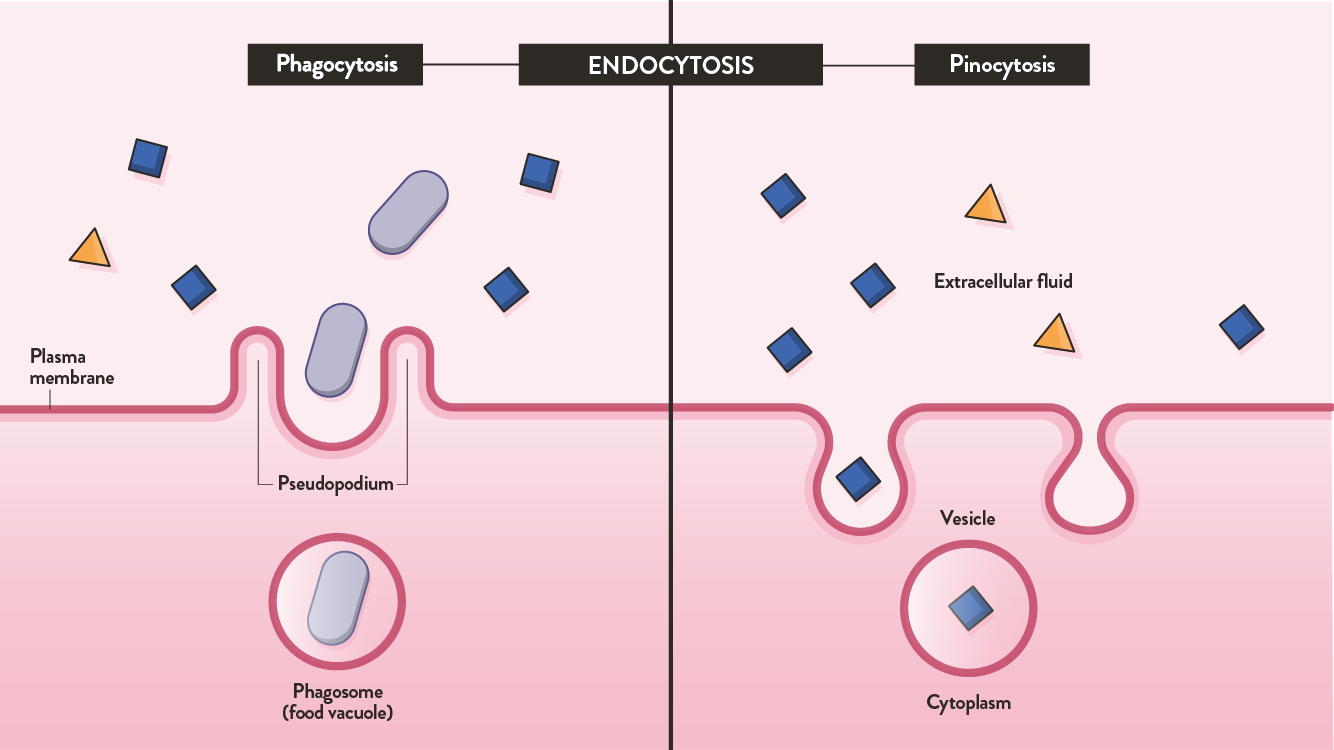
2 types of endocytosis: phagocytosis and pinocytosis.
Phagocytosis:
- A particle or substance binds to receptors on the cell'due south surface, stimulating the release of pseudopodia (extensions of the plasma membrane filled with cytoplasm).
- Pseudopodia surround the object until their membranes fuse, forming a phagocytic vesicle.
- The phagocytic vesicle pinches off from the prison cell membrane, entering the cell.
- The phagocytic vesicle fuses with lysosomes, which recycle or destroy the vesicle'due south contents.
Pinocytosis:
- Molecules bind to receptors located along the surface of the cellular membrane.
- The plasma membrane folds in, forming a pinocytic vesicle that contains the molecules and the extracellular fluid.
- The pinocytic vesicle detaches from the jail cell membrane inside the jail cell.
- The vesicle fuses with early endosomes where the contents plant inside are sorted.
Endocytosis instance
Macrophages are a type of white claret cell that play a central office in protecting mammals confronting pathogens like leaner and viruses. When a macrophage comes into contact with a virus, say a common cold virus in the bloodstream, it can demark to the virus'due south jail cell surface.
Next, the macrophage will class a vesicle around the virus, completely ingesting it. The vesicle and then travels to the cytosol and fuses with the lysosome, where the virus is broken downward. Some viruses replicate by "tricking" host cells into endocytosing them, at which bespeak the jail cell is hijacked by the virus and is instructed to replicate the virus genome and capsid.
What is exocytosis? Exocytosis definition and purposes
Exocytosis is the procedure by which cells move materials from inside the cell into the extracellular fluid. Exocytosis occurs when a vesicle fuses with the plasma membrane, assuasive its contents to be released outside the cell.
Exocytosis serves the post-obit purposes:
- Removing toxins or waste products from the cell's interior: Cells create waste product or toxins that must be removed from the cell to maintain homeostasis. For instance, in aerobic respiration, cells produce the waste products carbon dioxide and water during ATP formation. Carbon dioxide and water are removed from these cells via exocytosis.
- Facilitating cellular communication: Cells create signaling molecules like hormones and neurotransmitters. They are delivered to other cells following their release from the cell through exocytosis.
- Facilitating cellular membrane growth, repair, signaling and migration: When cells absorb materials from exterior the jail cell during endocytosis, they use lipids and proteins from the plasma membrane to create vesicles. When certain exocytotic vesicles fuse with the cellular membrane, they replenish the cell membrane with these materials.
Types of exocytosis
Regulated Exocytosis
Near exocytotic vesicles contain substances created inside the endoplasmic reticulum for apply elsewhere in the body, such as neurotransmitters or hormones. These molecules are and then packaged within a layer of membrane called a vesicle.
One time excreted from the endoplasmic reticulum, these vesicles are transported to the Golgi apparatus (also known every bit the Golgi circuitous) for further modification. The molecules are and then packaged once over again in a vesicle that makes its manner to the plasma membrane.
The release of these molecules from the prison cell is termed regulated exocytosis because the expulsion of the materials is controlled, or regulated, by extracellular signals that crusade membrane depolarization.
Constitutive Exocytosis
Constitutive exocytosis, in contrast, doesn't require any extracellular signals. The bulk of molecules traveling to the plasma membrane practise so using this pathway.
Afterward exocytosis, some exocytotic vesicles are incorporated into the plasma membrane (total vesicle fusion), while others return to the interior of the cell afterwards their contents accept been released (this is termed the "osculation-and-run" pathway). Others remain docked to the membrane, where they tin can exist used multiple times (the "kiss-and-stay" pathway).
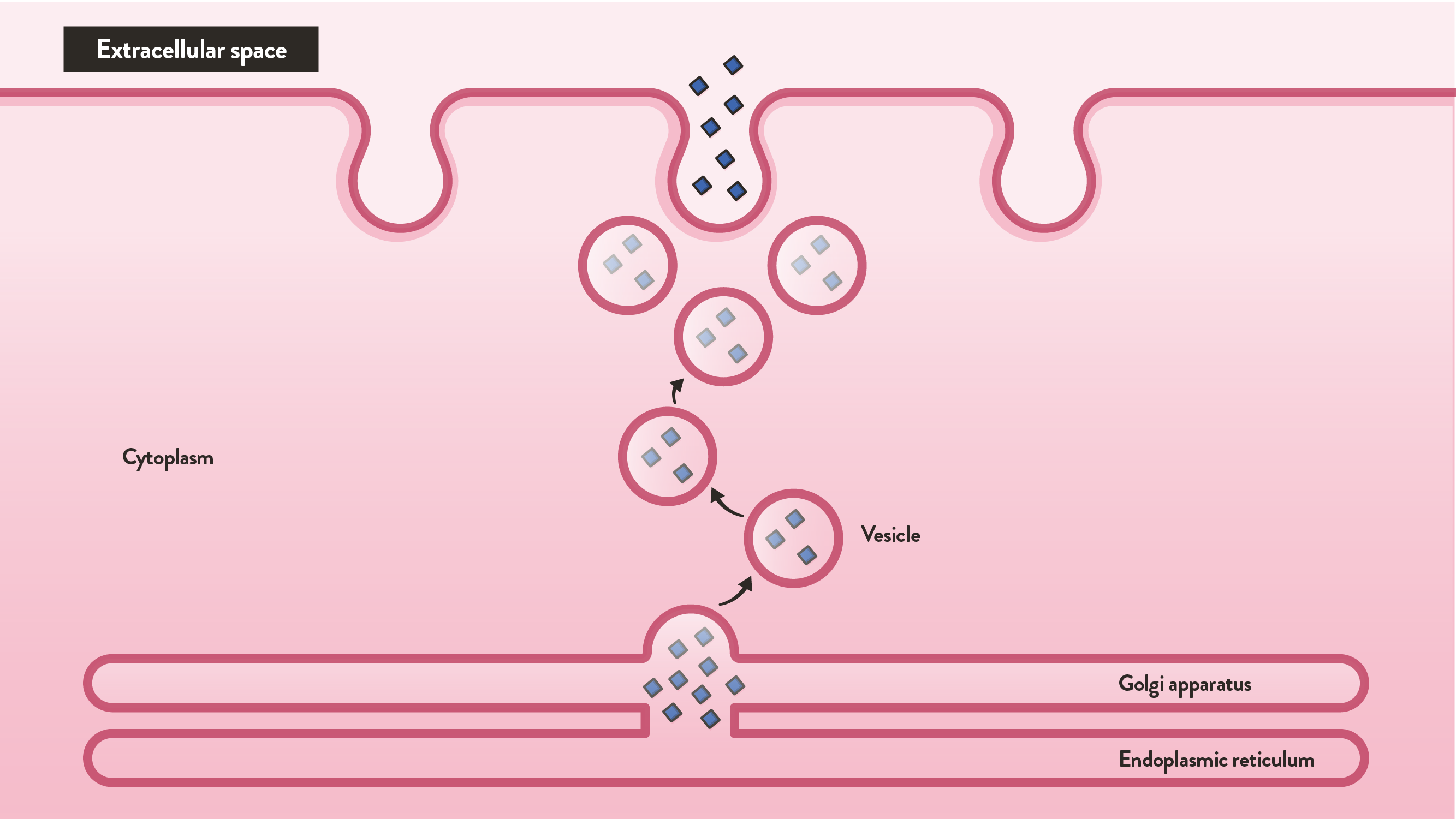
Exocytosis involves the passage of a vesicle from the endoplasmic reticulum or Golgi apparatus, through the cytoplasm to the cell membrane, where it fuses and releases its contents.
The steps of exocytosis
Beneath is an outline of the bones steps of exocytosis.
- A vesicle is formed, typically inside the endoplasmic reticulum and the Golgi appliance or early on endosomes.
- The vesicle travels to the prison cell membrane.
- The vesicle fuses to the plasma membrane, during which the 2 bilayers merge.
- The vesicle'south contents are released into the extracellular infinite.
- The vesicle either fuses with or separates from the jail cell membrane.
Exocytosis example
Allow's accept the macrophage that nosotros discussed in our endocytosis example. Once the white blood cell has engulfed a foreign pathogen eliminate it, certain parts of the pathogen are no longer needed. The macrophage gets rid of this waste matter material through exocytosis, during which vesicles carry out the unwanted pathogen material.
Endocytosis vs exocytosis: a comparing
| | Endocytosis | Exocytosis |
| Definition | The process of taking a particle or substance from outside of the cell and transferring information technology inside the cell using a vesicle. | The process of taking a substance or particle from inside of the cell and transferring information technology to outside the cell using a vesicle. |
| Function |
|
|
| Types |
|
|
| Examples | White claret cells engulfing a virus and eliminating it. | Releasing a neurotransmitter for cellular advice. |
petersonancon1968.blogspot.com
Source: https://www.technologynetworks.com/immunology/articles/endocytosis-and-exocytosis-differences-and-similarities-334059
0 Response to "Does Endocytosis and Exocytosis Get It Is Recycled and Used Again"
Post a Comment